
A changing collection of interesting projects, blogs, publications, discussions, approaches and links as an invitation to stimulate thinking.
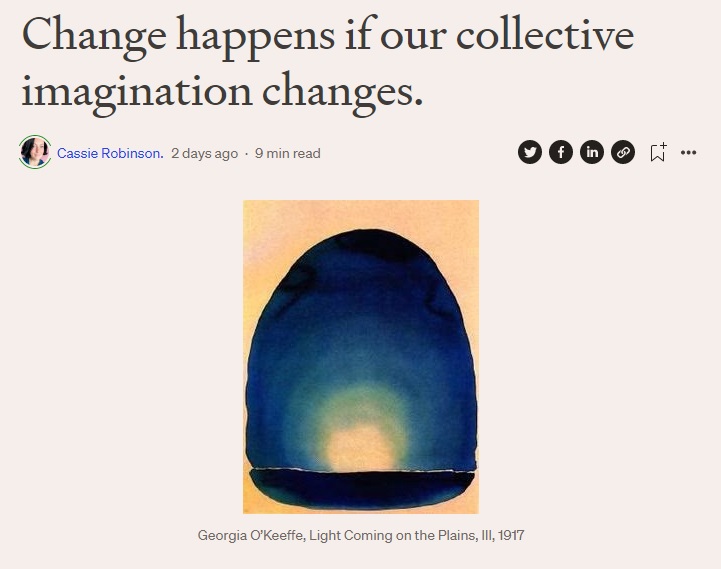
This food for thought looks to the future, and the importance of collective imagination for thinking creatively about future possibilities for a more equitable and healthy society.
The first – Change happens if our collective imagination changes is a short blog from Cassie Robinson with lots to think about and many links to people and projects actively engaged in this work. The second – The Imaginary Crisis – from Geoff Mulgan of UCL and Demos Helsinki – is a longer paper expanding on the history, theory and practice of public imagination.
Just published by the Centre for Public Impact, it explores emerging practice and ideas for how we might rethink public services using the framework of Human Learning Systems.

Our food for thought for May 2021, to coincide with our provoke15 with Prof Donna Hall is this 2021 report from New Local.
It explores community power and what it looks like – across the UK and internationally – and analyses existing evidence of the impact of community power.
This 2020 report from the Institute for Health Equity is the 10 years on update to the original Marmot Review looking at health inequalities in the UK and the social determinants of health.


Our food for thought for early 2021 is a 2019 paper by Liz Weaver, the CEO of the Tamarack Institute.
This looks at the challenges of community change, and some of the skills and mindsets needed to enable deeper and more robust system change.

The Community Paradigm from New Local sets out the case for a fundamental shift in how public services work – to share power with people, rather than hoard it. This is an updated copy of the original report – with an updated preface in 2021.
Here are three recent reports from 2020 – from the Young Foundation, the Relationships Project, and from Community Catalysts and the Local Area Coordination Network – each of which has something important to say about communities, civil society, and our responses to Coronavirus and lockdown.


This July 2019 report explores new approaches to commissioning that put communities at the heart of the process.
It is a further contribution to the radical manifesto for the future of public services – The Community Paradigm – from the New Local Government Network (now New Local). .
A recent report from the Carnegie Trust, written by Julia Unwin, looks at the importanceo f placing human relationships and kindness at the heart of public policy.


Since 2012, Wigan Council has transformed its approach to delivering services, underpinned by the idea of a new and radical relationship with the public – the ‘Wigan Deal’.
This June 2019 report from the Kings Fund is a fascinating read with much to learn – especially for the many other local authorities around the country struggling to sustain services in the face of continuing austerity.


This 2019 publication from the Institute for Global Prosperity, with support from the Joseph Rowntree Foundation, makes the case for a radical expansion of the social wage through the extension of existing, and introduction of new Universal Basic Services.

This 2019 report from Collaborate and other partners looks at creating social change by embracing complexity, and focussing on people, learning and systems.

Creative thinking about the economy from the Transnational Institute. This 2019 book is a collection of essays with examples of innovative approaches from around the world – some real food for thought about fresh approaches to creating a more just and sustainable economy.

Bringing people together, from the National Lottery Community Fund, looks at how community action can help tackle loneliness and isolation – with useful practical guidance and reference to projects nationally.

This 2018 report from the Local Trust and the New Local Government Network sets out 5 principles for a successful relationship between councils and communities.

A fascinating exploration of how we can use collective storytelling across sectors to navigate turbulent times and foster systems change.

This 2018 paper from the abcd Institute explores the four essential elements of an asset-based community development process.


Doing the Right Thing is a 2018 report from the National Association for Neighbourhood Management exploring the emerging shift from neighbourhood management to strategic locality working.

A report from 2018 from the US based Democracy Collaborative exploring housing and urban strategies for combatting displacement, expanding ownership, and building community wealth.
Three Horizons

Exploring futures and change through the International Future Forum’s 3 horizons model.

The Collaborate Foundation sets out a framework for effective collaboration in public services.

A 2015 report from the Health Foundation summarising the theory and evidence for working with people and communities on their health using an asset-based approach.

A 2014 report from Locality about how making services local by default and helping people to help themselves not only improves services but also saves money.


A systems based framework proposed by the Post Carbon Institute for building community resilience to tackle what they identify as the 4 E-crises – ecological, economic, energy and equity.

The 2017 manifesto for creating human cities – from the Human Cities Institute.

A report from Co-operative Councils on the benefits of community led housing with case studies and examples.